Showing posts with label 2010. Show all posts

Monday, June 13, 2011

The God of Small Things, Arundhati Roy

This was one of the most haunting books I've read all year. It's imagery is stunning. Roy weaves the history of this disjointed family after introducing readers to the tragic result of their individual actions. The structuring really pulls at your heart strings more, as the reader knows enough to react, but is drawn deeper into the chaos that Roy so cleverly and dexterously unfolds. This is precisely the sort of novel that merits the Man Booker, which it was awarded in 1997: creative in structure, lush in prose, politically aware, and globally inspired!

"Perhaps it's true that things can change in a day. That a few dozen hours can affect the outcome of whole lifetimes. And that when they do, those few dozen hours, like the salvaged remains of a burned house---the charred clock, the singed photograph, the scorched furniture---must be resurrected from the ruins and examined. Preserved. Accounted for. Little events, ordinary things, smashed and reconstitutred. Imbued with new meaning. Suddenly they become the bleached bones of a story." 

The maddeningly frustrating political and social climate of India in the 1960s imagines a world so complex and simultaneously fragile that this family saga can blow up in an unbelievably shattering way; the children, of course, pay the price in the ultimate way and are left to become horribly wounded, faithless adults. The scope of this novel makes for an intense experience. I had to read something seriously fluffy after this!

The God of Small Things, Arundhati Roy
ISBN: 0679457313 

Saturday, June 11, 2011

Before Night Falls, Reinaldo Arenas


This was probably the most detailed account of a slow, meticulous dehumanization that I've ever read. Arenas details his youth, socio-political background, and awareness of his sexuality during the tumultuous politics of Revolutionary Cuba, and leaves no stone of his experiences unturned.

Having taken many classes for my anthropology major dealing with issues of culture/human rights, I still wasn't adequately prepared for Arenas' experience. I can't believe that someone went through all of that and kept on, had the power to lecture and write once free of Cuba. Beware, though. This book isn't for the faint of heart. It can be rude, crude, and explicit. Arenas leaves nothing to the imagination. Understand that a generation of open minded youth had so many freedoms taken away, and lashed out for a sense of joy and truth wherever they could get it.

Books like this bring to the forefront the sad state of the American educational system; as a child, most of what my generation was taught and exposed to was from the American perspective (at least until college, of course). Seeing the Communist Revolution in Cuba as Arenas tells it shows how little understood these issues really are. Countries like Cuba, the Dominican Republic, Argentina, and Mexico have undergone such turbulent political forces in the past century, that have systematically torn to shreds every small piece of humanity people could hold onto. This memoir shows us how ill-informed we can be and reminds us why human rights world wide still have a hell of a fight ahead of them.

Before Night Falls, Reinaldo Arenas
ISBN: 1852428082 

Wednesday, May 18, 2011

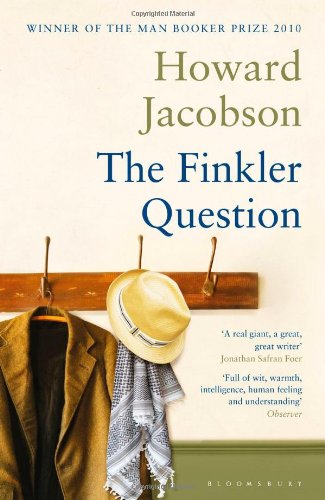
The Finkler Question, Howard Jacobson


Holy wow I loved this book. It took me about fifty pages to utterly fall in love with Jacobson's writing, but once I was into it, I loved it. There's so much witty banter and truly deep insight into the characters; even the less frequently mentioned characters (Treslove's sons and their respective mothers; the deceased Tyler) are incredibly well developed. 


The dialogue between Libor and Treslove is brilliant, heart wrenching even. The loyal yet heated rivalry between Treslove and Finkler was a little reminiscent of the lead two in McEwan's Booker winner (I recommend that book, too). 


Jacobson's sensitivity about stereotyping, racism, and cultural identities (belonging, as well as not) reminded me of Junot Diaz. I've made a lot of comparisons to really great books/writers because Jacobson is in good company when writing about cultural identity and relationships; but Jacobson gives you a larger scale perspective with his inclusion of the greater political issues; ie, the internal arguments within Judaism regarding Israel. Not only does it stamp the novel with a timely context, but it makes the discussion so much more universal than just the neighborhood in London this novel occupies. 


Jacobson covers all sides of the conversation with the tactfulness of an anthropologist, yet keeps the novel well paced with witty dialogue and character analysis. As guffaw-worthy as some of Nick Hornby's creations, but with more of Chang Rae Lee's wisdom; this book is one of my favorite releases from last year. 


The Finkler Question, Howard Jacobson
ISBN: 1408808870 

Tuesday, April 5, 2011

Double Trouble: Nick Hornby

Juliet, Naked, Nick Hornby
ISBN: 1594488878 

I read this as a pre-release from work, and knew I'd get through it in about two days (amidst all the other weekend mucking about). Hornby's books are always so amusing in their scenarios and character development, that you can't help but have a great time reading them. His prose really delivers incredible humorous characters, and this latest is no different!

Annie's fed up with her Crowe-crazed boyfriend and their fifteen year long indecision on whether the relationship is even worth the minute amount of work they put into it; Crowe is the very same musician that said boyfriend is enamored with, although he's as cowardly and spineless a man as can be (don't get me wrong, I liked him... he reminds me of all of those friends you have, that are so talented and smart yet never seem to do anything). In all of the hectic events circling both of these characters, they manage to meet, make things worse, and force a little bit of growing-up upon each other in true absurd Hornby style!

How to be Good, Nick Hornby
ISBN: 1573221937


I suppose I read this hoping it would be a funny look at marriages, the good guy/bad guy dynamics in relationships, and fidelity; but it was a three hundred page analysis of a woman's good deeds versus her bad deeds, and the excuses she makes that Hornby assumes we will all relate to.

Usually Hornby describes a likable if not muddled character who finds himself muddling up the lives of those he/she cares about, whilst trying to figure themselves out and growing in some way as a person after some giggle inducing madcap adventure; Katie was not likable, and the scenarios Hornby tries to make funny come off a bit depressing.

Hornby's typical rants of internal analysis aren't usually the bulk of the book, which makes for more amusing dialogue than we have here, as well as more chaotic WTF moments (that make the reader laugh, and the protagonist rethink their perspective); not here, however. David's sudden personality switch would have been more amusing if he had slipped periodically throughout, rather than in the last chapter suddenly admitting he wanted to get shot of GoodNews. I guess I just didn't find the characters' reactions that believable. It felt very forced by the end.

Points for demonstrating that smug righteousness is incredibly annoying, though! Thank God the son had some balls, too.

PS: Why am I more articulate when I find issues?!

Tuesday, March 8, 2011

Our Mutual Friend, Charles Dickens

Charles Dickens is typically an author that requires a lot of my attention; it can be hard work. Our Mutual Friend, though, wasn't too bad. Probably not the light reading I should have gone for on that eight hour flight, but it made for an interesting look from airport security when I had to empty out my purse! I digress...


Dickens' scope in characters alone is remarkable in this novel; the middle/lower class of London and it's inhabitants make for the bulk of the story, as we watch them attempt a renegotiating of their stations, by hook or by crook. The silliest of the novels chapters was the Greco-Romanesque chorus, made up of the aristocracy, lords, etc of London life. Their shallow banter highlighted the difference in life experiences to be had based on social status; they cajoled and bantered as the more central characters to the plot struggled for life and love.

Also, Dickens tips his hat to the ever problematic racial issues of London with his character Riah; he continues to persevere in his wisdom despite being scorned by most characters for his being Jewish, and helps to rescue Lizzie Hexam from Bradley Headstone's attentions for a while. I found the saddest moment in the novel to be Riah's conversation with Miss Jenny towards the end of the novel, when he apologizes for having fooled her, but was sad that it was so easy to fool everyone that he was a cold-hearted man, simply because it was expected of Jews.

Dickens' novel is ever mysterious and full of life. While it is a good chunk to read, don't be too intimidated; it's worth the effort!


Our Mutual Friend (Oxford World Classics)
ISBN: 0199536252